Short Communication: The Wasserstein distance
as a dissimilarity metric for comparing detrital
age spectra, and other geological distributions
Alex Lipp
Merton College, University of Oxford, Oxford, UK
and Pieter Vermeesch
Department of Earth Sciences, University College London, London, UK
Abstract
Distributional data such as detrital age populations or grain size
distributions are common in the geological sciences. As analytical
techniques become more sophisticated, increasingly large amounts
of distributional data are being gathered. These advances require
quantitative and objective methods, such as multidimensional scaling
(MDS), to analyse large numbers of samples. Crucial to such methods
is choosing a sensible measure of dissimilarity between samples. At
present, the Kolmogorov-Smirnov (KS) statistic is the most widely used
of these dissimilarity measures. However, the KS statistic has some
limitations such as high sensitivity to differences between the modes
of two distributions, and insensitivity to their tails. Here we propose
the Wasserstein-2 distance (W2) as an additional and alternative metric
for use in geochronology. Whereas the KS-distance is defined as the
maximum vertical distance between two empirical cumulative distribution
functions, the W2-distance is a function of the horizontal distances (i.e.,
age differences) between observations. Using a variety of synthetic and real
datasets we explore scenarios where W2 may provide greater geological
insight than the KS statistic. We find that in cases where absolute time
differences are not relevant (e.g., mixing of known, discrete age peaks), the
KS statistic can be more intuitive. However, in scenarios where absolute
age differences are important (e.g., temporally/spatially evolving sources,
thermochronology, and overcoming laboratory biases) W2 is preferable.
The W2-distance has been added to the R package IsoplotR, for immediate
use in detrital geochronology and other applications. The W2 distance can
be generalised to multiple dimensions, which opens opportunities beyond
distributional data.
1 Introduction
A distributional dataset is one where the information does not lie in individual
observations, but in the distribution of many observations associated with one
sample. Such data are common in the geological sciences, for example, detrital
mineral ages or grain size distributions. Zircon U-Pb ages, in igneous and detrital
samples, are one particularly widely used class of distributional data, which are used
inter alia to constrain sediment provenance, global magmatic processes,
and the evolution of plate tectonics (e.g., Condie et al., 2009; Cawood
et al., 2012; Reimink et al., 2021). Grainsize distributions are another common
form of geological distributional data. Analytical advances mean that increasingly
large amounts of distributional data are being generated in the Earth sciences
meaning that qualitative comparison of samples is becoming infeasible, and objective
dissimilarity metrics between samples must be used. Some measure of dissimilarity
(or more specifically, distance) is also required for many widely used statistical
methods such as clustering, ANOVA, and dimension reduction. Dissimilarity metrics
in geochronology at present are most commonly used for dimension reducing
techniques such as multi-dimensional scaling (MDS) or principal component
analysis (PCA). Such methods have become popular for analysing large
numbers of detrital age spectra simultaneuously (Vermeesch, 2013; Sharman
et al., 2018; Vermeesch, 2018a). Fitting models (e.g., sediment source partitioning)
using distributional data also requires a definition of dissimilarity for comparing
observed and predicted distributions (e.g., Amidon et al., 2005; De Doncker
et al., 2020).
For all uses, the choice of which dissimilarity metric to use is vital as different
metrics result in different numerical results and thus different geological
interpretations. In general, the most appropriate metric will depend on the
data being analysed and the scientific question under investigation. The
Kolmogorov-Smirnov (KS) distance, calculated as the maximum vertical distance
between two empirical cumulative distribution funtions (ECDFs) has emerged
as a ‘canonical’ distance metric between mineral age distributions (Berry
et al., 2001; Vermeesch, 2018a). However, the KS-distance has a number of
drawbacks, chiefly that as only the maximum vertical difference between ECDFs is
important, it is insensitive to variability in the tails of distributions. A number of
alternative dissimilarity measures have previously been proposed to address this
issue, including established methods such as the Kuiper statistic, and ad-hoc
dissimilarity measures such as the ‘likeness’ and ‘cross-correlation’ coefficients
(Satkoski et al., 2013; Saylor et al., 2012). Unfortunately, these alternatives have
drawbacks, including a propensity for the ad-hoc dissimilarity measures to produce
unintuitive results when applied to extremely large and/or precise datasets
(Vermeesch, 2018a).
In this paper we present an alternative to the KS-distance that does not suffer
from some of these limitations: the Wasserstein distance (also known as the
Earth-mover’s or Kantorovich–Rubinstein distance). To introduce the chief principle
behind this measure, let us consider a simple toy example. Table 1 contains four
samples (A through D), each of which contains exactly one single grain analysis:
Table 1: A toy, single-grain per sample dataset
As the KS distance is the vertical difference between ECDFs, it is insensitive to
the absolute, ‘horizontal’ age differences between individual observations. Thus, the
KS-distances between A and the other three samples are KS(A,B) = 0,
KS(A,C) = 1 and KS(A,D) = 1. Counter to our expectation, the KS-distance
cannot ‘see’ the relative age difference between sample A and samples C and D. For
the toy example, the Wasserstein distance simply corresponds to the horizontal
distance between the four samples. Thus, W(A,B) = 0, W(A,C) = 1, and
W(A,D) = 10, which is a more sensible result than that achieved with the
KS-distance.
In the following sections, we first introduce the Wasserstein distance in a more
realistic setting, and formally define it. Next we discuss how it can be decomposed
into intuitive terms that accord with how qualitatively, as geologists, we might
compare distributions. We then proceed to compare the Wasserstein distance to the
KS distance using a simple yet realistic synthetic example. Finally, we analyse a
series of case studies, analysing real datasets using both the Wasserstein
and KS distances. We thus evaluate the benefits and drawbacks of both
metrics, identifying scenarios when one metric may be preferred to the other.
Whilst we focus primarily on detrital age distributions, we emphasise that
much of the following discussion applies equally to any form of distributional
data.
2 The Wasserstein distance
The Wasserstein distance is a distance metric between two probability measures
from a branch of mathematics called ‘optimal transport’. Optimal transport is often
intuited in terms of moving piles of sand from one location to another with no loss or
gain of material (e.g., Villani, 2003). The problem that optimal transport solves is
finding the way to transport the sand such that the least sand is moved the least
distance. The Wasserstein distance is the cost associated with this most efficient
transportation. The association with moving piles of sand is why the Wasserstein
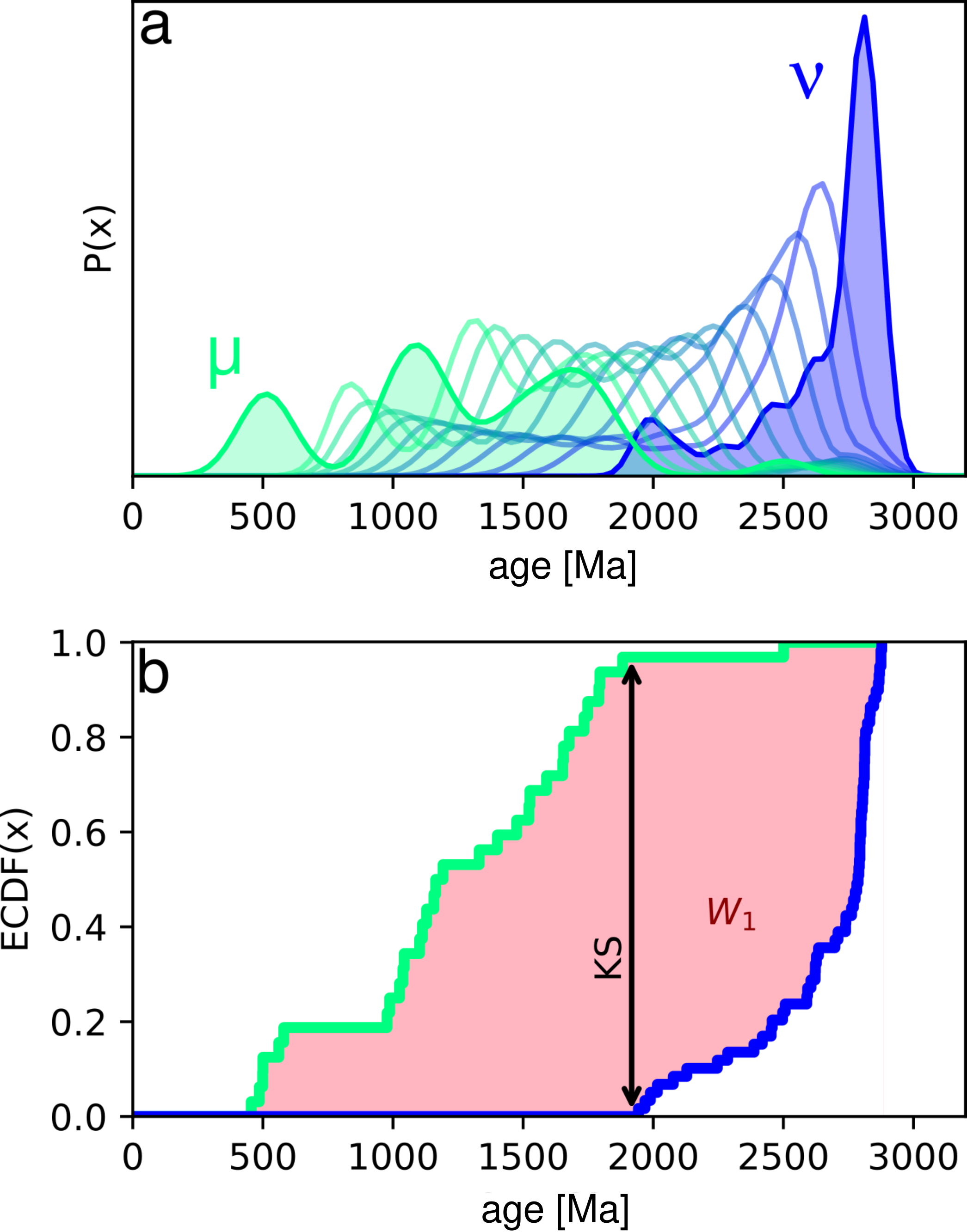
distance is often termed the Earth-mover’s distance. Figure 1a shows an example
of how one univariate probability distribution, μ, based on a detrital age
spectrum, is transformed into another, ν according to the optimal transport plan.
Elsewhere in the Earth sciences, the Wasserstein distance is increasingly
used for solving non-linear geophysical inverse problems (e.g., Engquist and
Froese, 2014; Métivier et al., 2016; Sambridge et al., 2022) and has been proposed
as a tool for fitting hydrographs (Magyar and Sambridge, 2023). Full mathematical
treatments of the Wasserstein distance and optimal transport are beyond the
scope of this paper, but interested readers are referred to Villani (2003) or
Peyré and Cuturi (2019). A geophysical perspective is given in Sambridge
et al. (2022).
2.1 Formal definition
We consider two univariate probability distributions μ and ν which have cumulative
distribution functions (CDFs) M and N respectively. The pth Wasserstein distance
between μ and ν is given by:
where M-1 indicates the inverse of the CDF M and 0 ≤ t ≤ 1 (Villani, 2003).
Note that this definition of Wp assumes that the cost-function is given by
|x - y|p (e.g., the Euclidean distance where p = 2), which is the case for
most distributional data in geology. In the further special case of p = 1 (i.e.,
the first Wasserstein distance, W1), Equation 1 can be re-written simply
as:
which is the area between two CDFs (e.g., Figure 1b). Recall that the KS-distance
between two distributions is the maximum distance between the two corresponding
CDFs. Whilst the W1 is easily visualised, we actually use the W2 going forwards
as the squared distance (i.e., p = 2) between observations is the standard
distance metric in most statistical analyses (e.g., least squares regression).
Additionally, W2 decomposes into readily interpretable terms, as discussed
below.
We focus on these univariate instances as they apply to the most common
geological distributional data including detrital age distributions and grain
size distributions. However, we note that the Wasserstein distance is, in
general, multivariate. As a result, some form of the Wasserstein distance
could prove useful for analysing a number of other geological datasets such
as the geochemical compositions of detrital minerals, or joint U-Pb and
Lu-Hf isotope analysis (see Vermeesch et al., 2023). Statistics for comparing
distributional data in multiple dimensions are increasingly needed (Sundell and
Saylor, 2021).
Like the KS distance, W2 satisfies the triangle inequality, and as such is a true
metric. This property means that classical, as well as metric & non-metric MDS can
be used with a W2 defined dissimilarity matrix. As W2 is sensitive to absolute time
differences, metric (or classical) MDS, which seek to preserve absolute distances, may
be preferable to non-metric MDS. For the rest of this manuscript, metric MDS is
used.
2.2 Decomposition
A particularly useful property of W2 between two univariate distributions
is that it can be decomposed in terms of the differences between the two
distributions’ location, spread and shape. Irpino and Romano (2007) show
that:
where μ is the mean of μ, σμ is the standard deviation of μ and ρμν is the Pearson
correlation coefficient between the quantiles of the distributions μ and ν. These three
terms also accord with, qualitatively, how as geologists we might compare two
distributions.
2.3 Discrete data
Most distributional data in the Earth sciences do not, in raw form, follow continuous
probability distributions. Instead, samples may be discrete sets of observations, e.g.,
lists of individual mineral ages. The above formulations can be easily applied to such
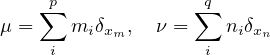
cases by describing the probability functions μ and ν as weighted sums of δ functions.
For example, let us consider two samples xm and xn with p and q numbers of
observations respectively:
where m and n are weight vectors, such that ∑
mi = ∑
ni = 1. In most
geological cases these weights would be uniform, mi = 1∕p; ni = 1∕q, giving each
observation within a sample equal weight. In this scenario, M and N are the familiar
empirical cumulative distribution functions (ECDF), given as a series of step
functions (e.g., Figure 1b).
2.4 A synthetic example
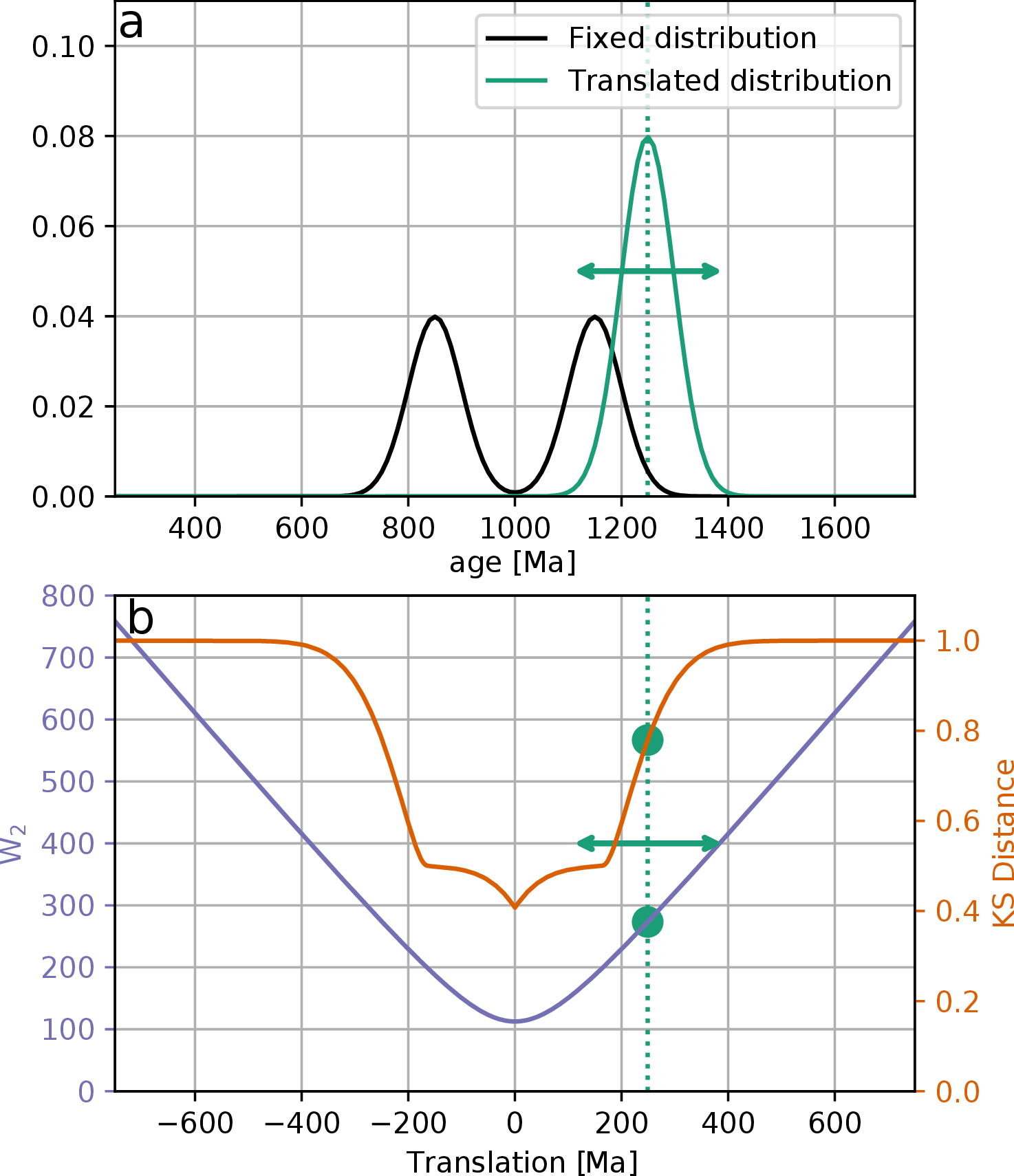
To demonstrate the intuition of W2 we explore a simple synthetic example. We
consider two probability density functions of mineral ages: a bimodal distribution
and a unimodal distribution, both constructed from Gaussians with the
same scale (Figure 2a). We fix the bimodal distribution at 1000 Ma, but
translate the unimodal distribution along the time axis. For each translated
distribution we calculate both the KS-distance and W2. Figure 2b displays the
behaviour of both distances under this scenario. The KS-distance shows an
unexpectedly complex response containing a series of steps, as the peaks of the
distributions align and misalign. At around ±400 Ma, once the distributions
stop overlapping, the KS-distance plateaus at its maximum value of 1. By
contrast, W2 increases monotonically with increasing distance. Away from the
origin, W2 approximates a linear function of the amount of translation, as is
predicted from Equation 3. At the origin, the non-zero value of W2 is the cost of
turning the unimodal distribution into the bimodal distribution without
translation.
We argue that the behaviour of W2 is more geologically intuitive than the
KS-distance under this scenario. It is useful geological information if two
distributions differ in their means by 400, 500 or 1000 Ma, but if the distributions do
not overlap, the KS-distance is insensitive to this. The Wasserstein distance is, by
contrast, sensitive to the absolute offset between non-overlapping distributions.
Additionally, the stepped response of the KS-distance under translation is
undesirable. Under the simple operation of translating a unimodal distribution, we
would expect our dissimilarity to increase at a constant, or at least predictable
(e.g., quadratic) rate. The change of the KS-distance with translation is,
unintuitively, non-linear. By contrast, the W2 increases linearly with respect to
translation.
We reiterate that at a translation of 0 Ma, W2 (and the KS distance) is still
non-zero, reflecting the fact that even when the average ages are aligned,
the shapes of the uni-modal and bi-modal distributions do not match. This
illustrates the tendency of W2 in geochronological data to prioritise aligning
the average ages of distributions before considering matching individual
peaks. Such behaviour contrasts with approaches that seek to only match
probability peaks neglecting any information of absolute ages Saylor and
Sundell e.g., 2016.
3 Discussion
As stated above, the most appropriate dissimilarity metric to use will depend on the
scientific question being answered. In general, the Wasserstein distance is most
appropriate when absolute differences along the time axis (or more generally, the
x-axis) provide useful information to solving the geologic problem. The KS distance
however is more appropriate when the size of the time differences between peaks is
not relevant. Both the KS distance and the W2 are calculated in terms of
differences between ECDFs. Due to these similarities in construction, in many
cases the results from using the KS and W2 are, encouragingly, similar. One
exception is whether ages are log transformed prior to analysis. Because the KS
distance considers only the order of the ages, it will be the same whether a log
transform is used or not. W2 however will be different, and will consider relative
not absolute age differences. Such an example is discussed below (Figure
5).
Here we discuss a variety of realistic scenarios where the KS and W2 may result
in different interpretations. In each, we evaluate the advantages and disadvantages of
using W2 or KS. These case-studies can be used to determine which metric is most
appropriate for a particular scenario.
3.1 Discriminating contributions from discrete endmembers
We first consider a scenario where the samples are assumed to be mixtures, in
differing proportions, of some known or unknown fixed endmembers. This situation is
one where absolute distance along the time-axis is not relevant, as the nature of the
endmembers is not sought, simply their relative contributions to a set of mixtures.
Instead, it is vertical differences in the probability at a given age that is relevant. The
KS distance, which is sensitive to such vertical differences in age distributions is
better suited for this than W2. Indeed, in such a scenario the W2 can result in some
unintuitive behaviour.
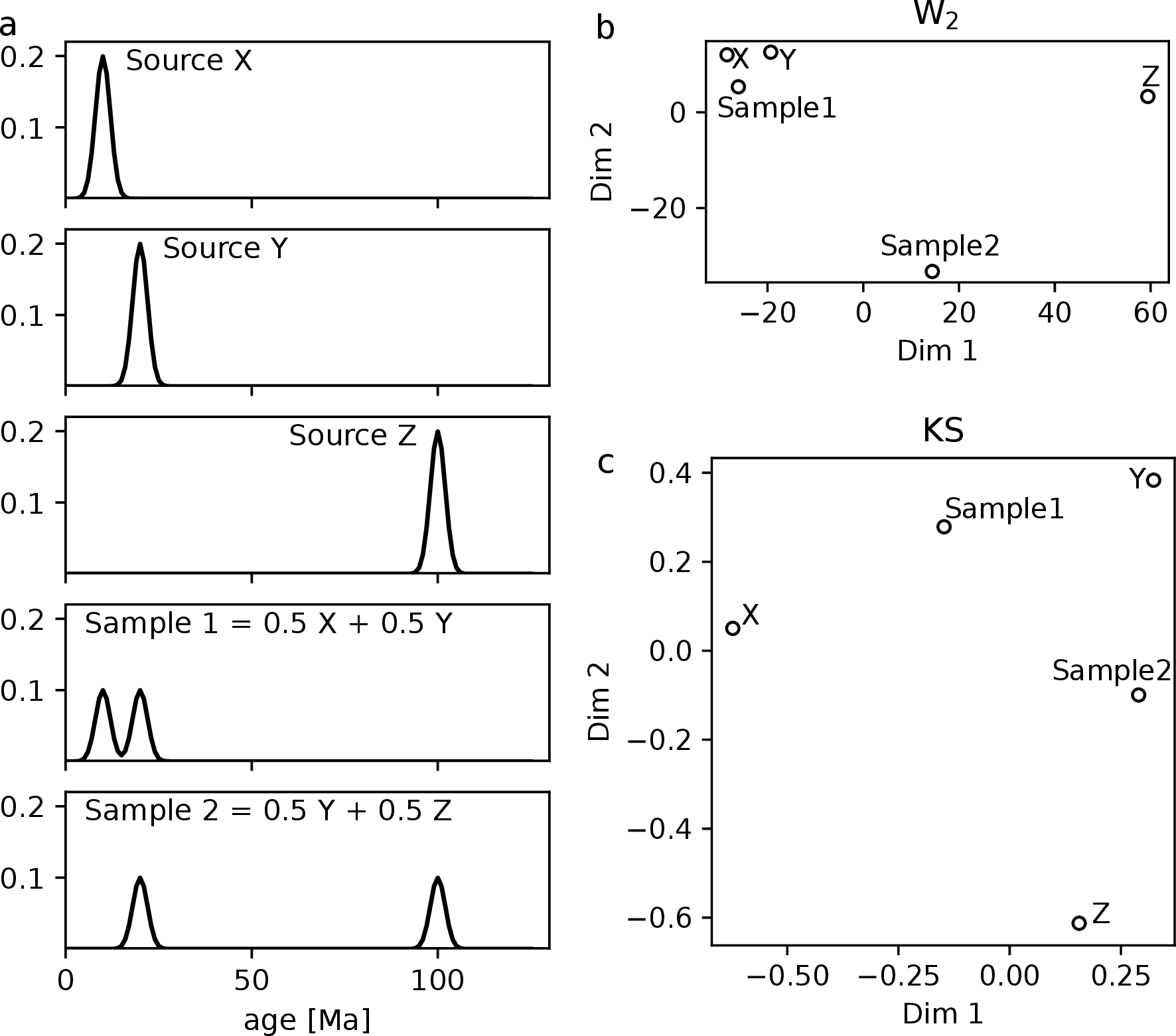
For example, let us consider three unimodal potential sediment sources, as shown
in Figure 3a. We now consider two mixture samples. The first is an equal mixture of
X and Y, and the second an equal mixture of Y and Z (bottom two plots, Figure 3a).
Geologically, we would expect these samples to be about half as similar to the two
source endmembers. However, a W2 MDS map identifies these samples as being
removed from their two endmembers (Figure 3b). Additionally, because of the
absolute time difference between Source Z and the other sources, Sample 2 is treated
as a considerable outlier. The KS distance performs better here, placing
the mixtures approximately halfway between the expected endmembers.
However, in such a well defined mixing scenario as this, methods such as
endmember mixture modelling may be more appropriate than statistical dimension
reduction Weltje e.g., 1997; Sharman and Johnstone e.g., 2017; Dietze and
Dietze e.g., 2019.
3.2 Temporally varying source age distributions
In contrast, scenarios where the shape of sediment source age distributions evolves
in space and time are well suited to using W2. This is because W2 considers
all parts of a distribution, whereas the KS only compares one point, the
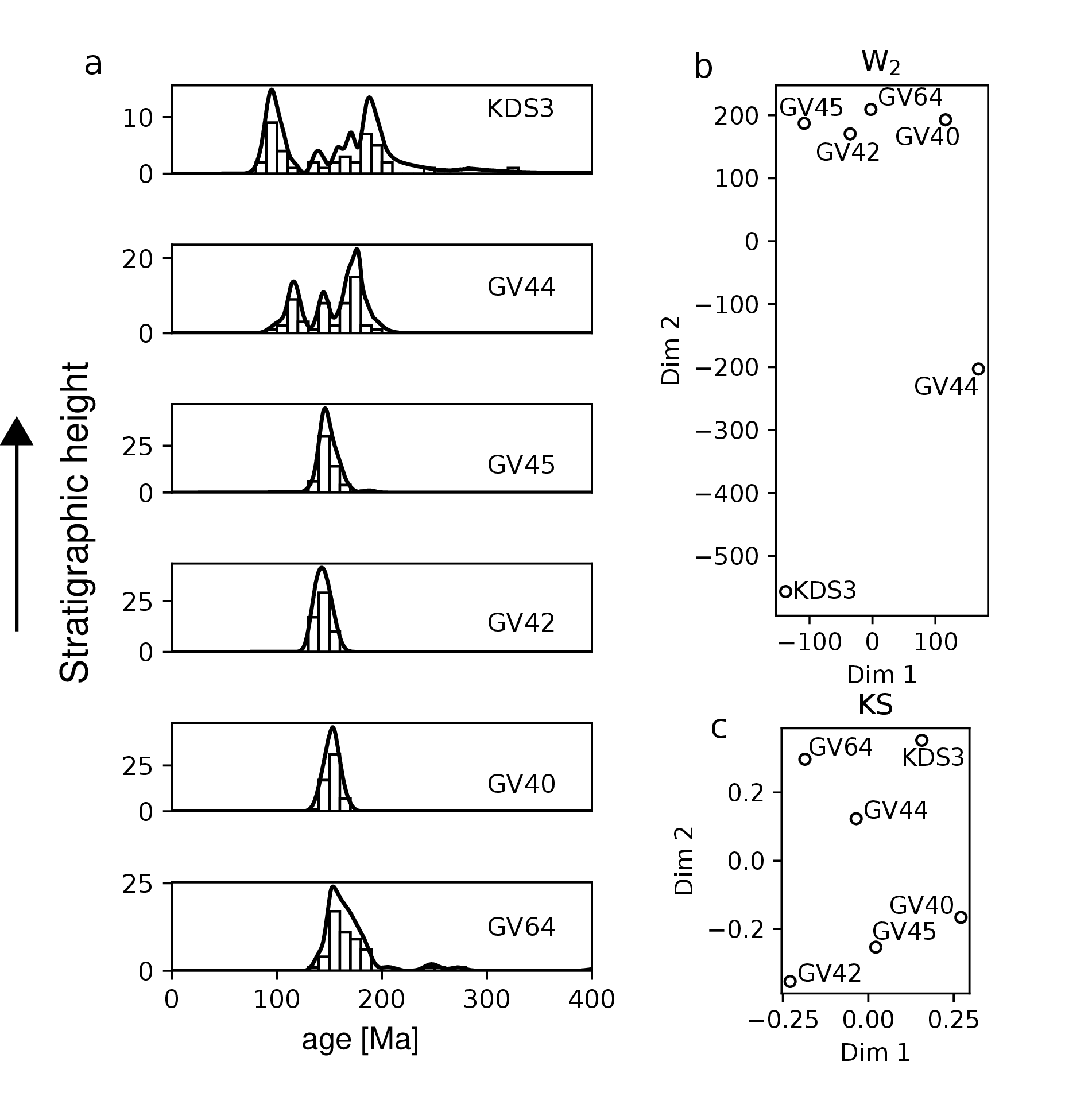
location of maximum ECDF separation. For example, Figure 4 displays detrital
zircon age distributions gathered by DeGraaff-Surpless et al. (2002) from
sediments from a section (Cache Creek) across the Great Valley Group in
California, USA. The age populations are shown as KDEs and histograms, in
stratigraphic order, in Figure 4a. The uppermost samples show an increasingly
broad distribution than the lower four unimodal samples. DeGraaff-Surpless
et al. (2002) attribute this trend, inter alia, to expanding sediment source
areas.
Figures 4b–c display MDS maps calculated using W2 and KS respectively. The
W2 map clearly identifies the stratigraphic order of the samples by the changing
distribution shape. Additionally, it clusters the four unimodal samples together. By
contrast, the KS map does not identify the stratigraphic trend, locating the
lowermost stratigraphic sample GV64 with the uppermost samples KDS3 and GV44.
We conclude then that the W2 has better captured the geological information in this
scenario.
3.3 Thermochronology
In thermochronology, age distributions shift along the time-axis according to thermal
signals (e.g., exhumation). In many thermochronological studies, we may
seek to characterise how such a signal evolves in space and time. For this
question absolute distance along the time-axis is useful information and so
the W2 may be more effective than the KS distance. For example, Wobus
et al. (2003) use 40Ar/39Ar detrital mica thermochronometry to explore spatially
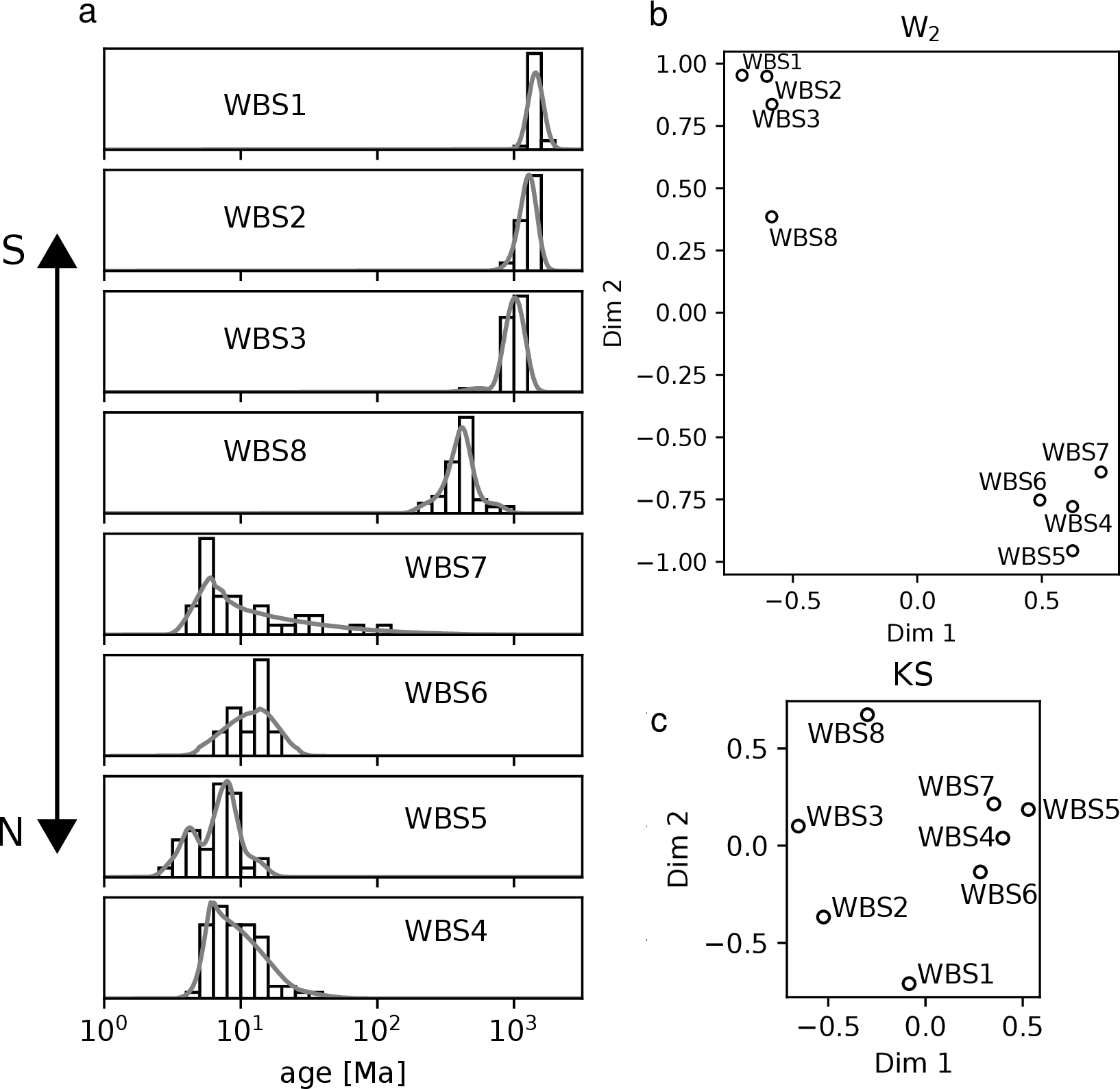
varying exhumation along a spatial transect in the Himalaya. The KDEs of
the samples are shown in Figure 5a arranged south to north. The southern
samples (WBS1, WBS2, WBS3, WBS8) show old exhumation signals, but a
dramatic shift to younger ages is observed north of a distinct physiographic
transition. MDS maps of these samples are shown using the KS distance
and W2 in Figures 5b–c respectively. As there is limited overlap between
the samples, the KS distance struggles to capture the NS progression in
exhumation age. Whilst the physiographic division is found, it weights it equally to
variation within one cluster. By contrast, the W2 map correctly identifies
the simple temporal and geographical trend of the samples from south to
north.
3.4 Combining data from multiple laboratories
A final scenario where the W2 could be preferable is when comparing samples
from different laboratories which are affected by inter-laboratory bias. Košler
et al. (2013) provided ten different laboratories with identical synthetic zircon
samples with a known age distribution. Different instruments introduced small
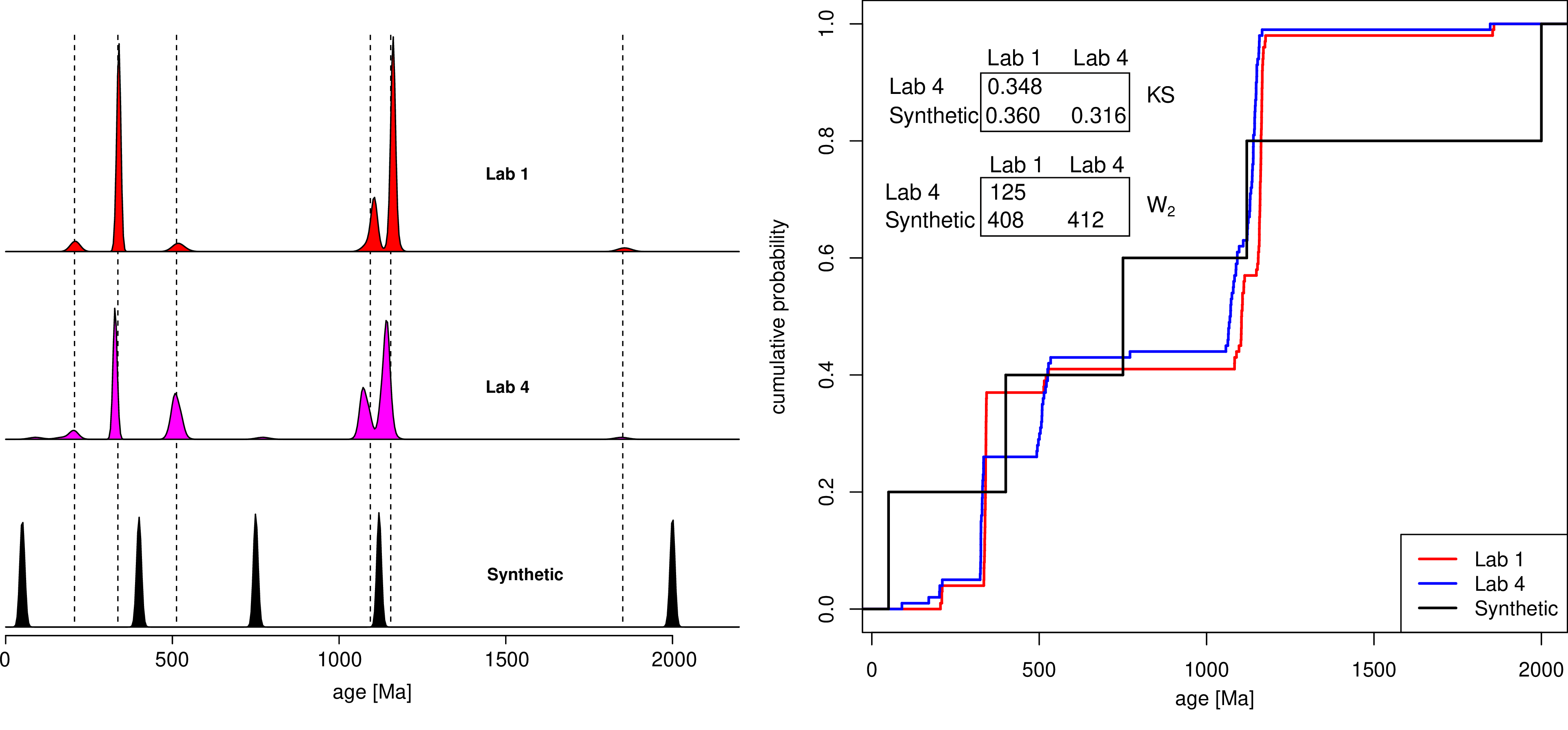
differences in the ages of each peak. For example, in Figure 6 we display the results
from Lab 1 (red) and Lab 4 (pink) as KDEs. The expected peak at ~ 1200 Ma
(dashed line) is offset between the two samples. As it is the maximum distance
between two ECDFs, the KS distance is very sensitive to minor offsets in sharply
defined peaks. In this case, the KS distance between these theoretically identical
samples is large at 0.348, which is over one third of the maximum possible distance
between samples. Indeed, the KS distance considers a synthetic, purposefully
misaligned series of peaks (black KDE) to be more similar to the Lab 4 results
than the results from Lab 1. The W2 distance, does not suffer from this
oversensitivity to minorly offset peaks and correctly identifies the samples from
Lab 1 and Lab 4 as being much more similar than the random synthetic
distribution.
4 Implementation
We provide example code ( github.com/AlexLipp/detrital-wasserstein) in
both Python and R that demonstrates how to calculate the W2 between two
univariate distributions (U-Pb zircon ages). For these examples we make use of
the the POT and transport packages in Python and R respectively which
implement solutions to Equation 1 (Flamary et al., 2021; Schuhmacher
et al., 2022).
4.1 IsoplotR
Additionally, the W2-distance has been added to the IsoplotR package in R,
which calculates dissimilarity matrices and MDS maps (Vermeesch, 2018b).
This software can be accessed using an (online) graphical user interface, at
isoplotr.es.ucl.ac.uk. Alternatively, the function can also be accessed from the R
command line. The following snippet uses W2 to calculate an MDS map for the
dataset from Wobus et al. (2003) discussed in the manuscript (Figure 5). The data
required is also available at the above repository. Note that the MDS map
produced may show slight differences to those in the manuscript due to
dependence of metric MDS on a random state variable. This variability can
introduce reflections/rotations of the data, but the underlying structure is
unchanged.
# load the package:
library(IsoplotR)

# Load in the data
DZ <- read.data("wobus.csv",method="detritals")

# example 1. calculate the W2 distance matrix for the dataset:
d <- diss(DZ,method="W2")

# example 2. apply MDS to the dataset:
mds(DZ,method="W2")
5 Conclusions
The second Wasserstein distance, W2, is an effective metric for comparing
distributional data in the geological sciences such as detrital age spectra or grain size.
Unlike the KS distance, W2 can be extended to further dimensions. W2 is a function
of the horizontal distances between observations, in contrast to the KS distance,
which corresponds to vertical differences between ECDFs. Using a variety of case
studies we explore scenarios where the W2 may or may not be preferable to the KS
distance. In scenarios where discrete, known age peaks are mixed, the KS distance
may be preferable. However, in other scenarios where absolute differences along the
time axis are useful information, W2 is preferable. Example scenarios include
spatially/temporally evolving source distributions, thermochronological data, and
combining detrital samples from different laboratories. The Wasserstein distance has
been added to the IsoplotR software, and example scripts are provided in Python and
R.
Code availability: The code and data repository is found at
github.com/AlexLipp/detrital-wasserstein
Author contributions: AGL conceived the project, both authors contributed to
development, writing, and software production.
Competing interests: PV is an Associate Editor of Geochronology
Acknowledgements
AGL is funded by a Junior Research Fellowship from Merton College, Oxford. PV is
supported by NERC Standard Grant #NE/T001518/1. This work benefited from
discussions with Malcolm Sambridge & Kerry Gallagher. We thank reviews from Joel
Saylor, an anonymous reviewer, and the associate editor Michael Dietze for their
constructive feedback.
References
Amidon, W. H., Burbank, D. W., and Gehrels, G. E.: Construction of
detrital mineral populations: insights from mixing of U–Pb zircon ages in
Himalayan rivers, Basin Research, 17, 463–485, https://doi.org/10.1111/j.
1365-2117.2005.00279.x, 2005.
Benamou, J.-D., Carlier, G., Cuturi, M., Nenna, L., and Peyré, G.: Iterative
Bregman Projections for Regularized Transportation Problems, SIAM
Journal on Scientific Computing, 2, A1111–A1138, https://doi.org/10.
1137/141000439, publisher: Society for Industrial and Applied Mathematics,
2015.
Berry, R. F., Jenner, G. A., Meffre, S., and Tubrett, M. N.: A
North American provenance for Neoproterozoic to Cambrian sandstones
in Tasmania?, Earth and Planetary Science Letters, 192, 207–222,
https://doi.org/10.1016/S0012-821X(01)00436-8, 2001.
Cawood, P., Hawkesworth, C., and Dhuime, B.: Detrital zircon record and
tectonic setting, Geology, 40, 875–878, https://doi.org/10.1130/G32945.1,
2012.
Condie, K. C., Belousova, E., Griffin, W. L., and Sircombe, K. N.:
Granitoid events in space and time: Constraints from igneous and detrital
zircon age spectra, Gondwana Research, 15, 228–242, https://doi.org/10.
1016/j.gr.2008.06.001, 2009.
De Doncker, F., Herman, F., and Fox, M.: Inversion of provenance data and
sediment load into spatially varying erosion rates, Earth Surface Processes
and Landforms, 45, 3879–3901, https://doi.org/https://doi.org/10.1002/
esp.5008, 2020.
DeGraaff-Surpless, K., Graham, S. A., Wooden, J. L., and McWilliams,
M. O.: Detrital zircon provenance analysis of the Great Valley Group,
California: Evolution of an arc-forearc system, GSA Bulletin, 114, 1564–1580,
https://doi.org/10.1130/0016-7606(2002)114⟨1564:DZPAOT⟩2.0.CO;2,
2002.
Dietze, E. and Dietze, M.: Grain-size distribution unmixing using the
R package EMMAgeo, E&G Quaternary Science Journal, 68, 29–46,
https://doi.org/10.5194/egqsj-68-29-2019, 2019.
Engquist, B. and Froese, B. D.: Application of the Wasserstein metric
to seismic signals, Communications in Mathematical Sciences, 12, 979–988,
https://doi.org/10.4310/CMS.2014.v12.n5.a7, 2014.
Flamary, R., Courty, N., Gramfort, A., Alaya, M. Z., Boisbunon, A.,
Chambon, S., Chapel, L., Corenflos, A., Fatras, K., Fournier, N., Gautheron,
L., Gayraud, N. T. H., Janati, H., Rakotomamonjy, A., Redko, I., Rolet, A.,
Schutz, A., Seguy, V., Sutherland, D. J., Tavenard, R., Tong, A., and Vayer,
T.: POT: Python Optimal Transport, Journal of Machine Learning Research,
22, 1–8, 2021.
Irpino, A. and Romano, E.: Optimal histogram representation of large data
sets: Fisher vs piecewise linear approximation, in: Actes des cinquièmes
journées Extraction et Gestion des Connaissances, vol. E-9, pp. 99–110,
Namur, Belgium, 2007.
Košler, J., Sláma, J., Belousova, E., Corfu, F., Gehrels, G. E., Gerdes,
A., Horstwood, M. S. A., Sircombe, K. N., Sylvester, P. J., Tiepolo, M.,
Whitehouse, M. J., and Woodhead, J. D.: U-Pb Detrital Zircon Analysis –
Results of an Inter-laboratory Comparison, Geostandards and Geoanalytical
Research, 37, 243–259, https://doi.org/10.1111/j.1751-908X.2013.00245.x,
2013.
Magyar, J. C. and Sambridge, M.: Hydrological objective functions and
ensemble averaging with the Wasserstein distance, Hydrology and Earth
System Sciences, 27, 991–1010, https://doi.org/10.5194/hess-27-991-2023,
2023.
Morton, A., Fanning, M., and Milner, P.: Provenance characteristics of
Scandinavian basement terrains: Constraints from detrital zircon ages in
modern river sediments, Sedimentary Geology, 210, 61–85, https://doi.org/10.1016/j.sedgeo.2008.07.001, 2008.
Métivier, L., Brossier, R., Mérigot, Q., Oudet, E., and Virieux, J.: An
optimal transport approach for seismic tomography: application to 3D full
waveform inversion, Inverse Problems, 32, 115 008, https://doi.org/10.
1088/0266-5611/32/11/115008, 2016.
Peyré, G. and Cuturi, M.: Computational Optimal Transport, Foundations
and Trends in Machine Learning, 11, 355–607, 2019.
Reimink, J. R., Davies, J. H. F. L., and Ielpi, A.: Global zircon analysis
records a gradual rise of continental crust throughout the Neoarchean, Earth
and Planetary Science Letters, 554, 116 654, https://doi.org/10.1016/j.
epsl.2020.116654, 2021.
Sambridge, M., Jackson, A., and Valentine, A. P.: Geophysical inversion
and optimal transport, Geophysical Journal International, 231, 172–198,
https://doi.org/10.1093/gji/ggac151, 2022.
Satkoski, A. M., Wilkinson, B. H., Hietpas, J., and Samson, S. D.: Likeness
among detrital zircon populations—An approach to the comparison of
age frequency data in time and space, GSA Bulletin, 125, 1783–1799,
https://doi.org/10.1130/B30888.1, 2013.
Saylor, J., Stockli, D., Horton, B., Nie, J., and Mora, A.: Discriminating
rapid exhumation from syndepositional volcanism using detrital zircon double
dating: Implications for the tectonic history of the Eastern Cordillera,
Colombia, Bulletin of the Geological Society of America, 124, 762–779,
https://doi.org/10.1130/B30534.1, 2012.
Saylor, J. E. and Sundell, K. E.: Quantifying comparison of large detrital
geochronology data sets, Geosphere, 12, 203–220, https://doi.org/10.1130/
GES01237.1, 2016.
Schuhmacher, D., Bähre, B.,
Gottschlich, C., Hartmann, V., Heinemann, F., and Schmitzer, B.: transport:
Computation of Optimal Transport Plans and Wasserstein Distances, URL
https://cran.r-project.org/package=transport, 2022.
Sharman, G. R. and Johnstone, S. A.: Sediment unmixing using detrital
geochronology, Earth and Planetary Science Letters, 477, 183–194,
https://doi.org/10.1016/j.epsl.2017.07.044, 2017.
Sharman, G. R., Sharman,
J. P., and Sylvester, Z.: detritalPy: A Python-based toolset for visualizing
and analysing detrital geo-thermochronologic data, The Depositional Record,
4, 202–215, https://doi.org/10.1002/dep2.45, 2018.
Sundell, K. E. and Saylor,
J. E.: Two-Dimensional Quantitative Comparison of Density Distributions
in Detrital Geochronology and Geochemistry, Geochemistry, Geophysics,
Geosystems, 22, e2020GC009 559, https://doi.org/10.1029/2020GC009559,
2021.
Vermeesch, P.: Multi-sample comparison of detrital age distributions,
Chemical Geology, 341, 140–146, https://doi.org/10.1016/j.chemgeo.2013.
01.010, 2013.
Vermeesch,
P.: Dissimilarity measures in detrital geochronology, Earth-Science Reviews,
178, 310–321, https://doi.org/10.1016/j.earscirev.2017.11.027, 2018a.
Vermeesch, P.: IsoplotR: A free and open toolbox for geochronology,
Geoscience Frontiers, 9, 1479–1493, https://doi.org/10.1016/j.gsf.2018.04.
001, 2018b.
Vermeesch, P., Lipp, A. G., Hatzenbühler, D., Caracciolo, L., and Chew,
D.: Multidimensional scaling of varietal data in sedimentary provenance
analysis, Journal of Geophysical Research: Earth Surface, p. e2022JF006992,
https://doi.org/10.1029/2022JF006992, 2023.
Villani, C.: Topics in Optimal Transportation, no. 58 in Graduate studies
in mathematics, American Mathematical Soc., 2003.
Weltje, G. J.: End-member modeling of compositional
data: Numerical-statistical algorithms for solving the explicit mixing problem,
Mathematical Geology, 29, 503–549, https://doi.org/10.1007/BF02775085,
1997.
Wobus, C. W., Hodges, K. V., and Whipple, K. X.: Has focused denudation
sustained active thrusting at the Himalayan topographic front?, Geology, 31,
861–864, https://doi.org/10.1130/G19730.1, 2003.